
President Thaçi is received at the House of Representatives of the Canadian Parliament, meets with Speaker Regan
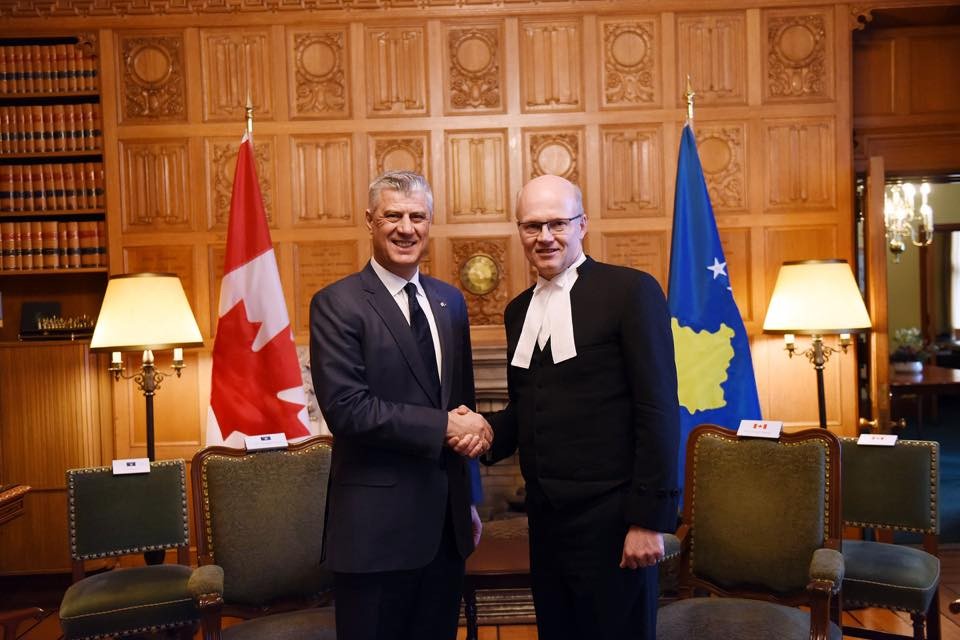
Ottawa, Canada, November 22 – The President of the Republic of Kosovo, Hashim Thaçi, was received today by the Speaker of the House of Representatives of the Parliament of Canada, Mr. Geoff Regan, with whom he discussed about the cooperation between Kosovo and Canada and the deepening of this cooperation, especially in the parliamentary field.
President Thaçi is received in the Canadian Senate, discusses with the Chairman
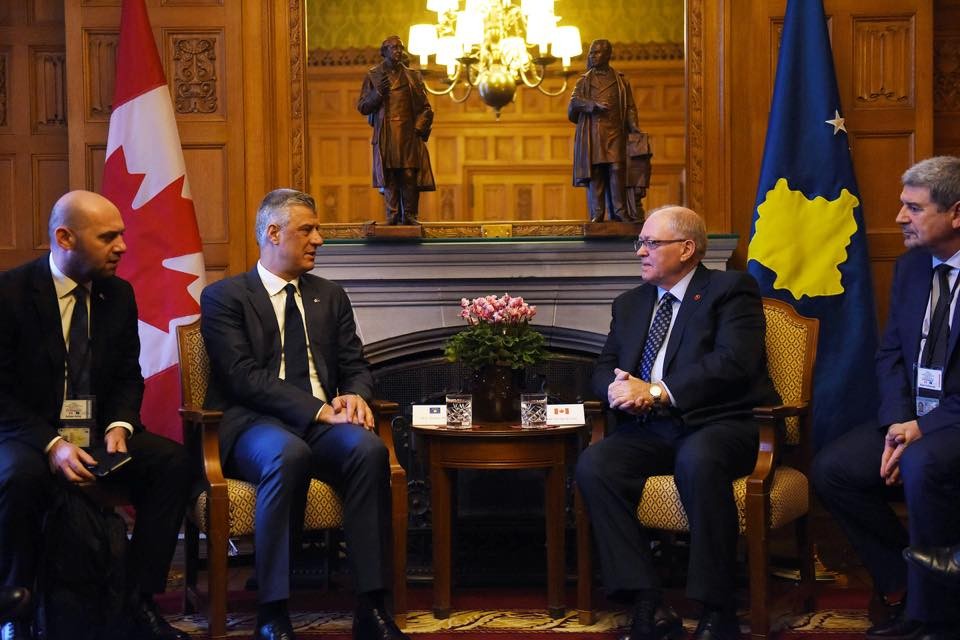
Ottawa, Canada, November 22 – The President of the Republic of Kosovo, Hashim Thaçi, was received today by the Chairman of the Senate of Canada, George Furey, with whom he discussed about the cooperation between Kosovo and Canada and the deepening of this cooperation.
President Thaçi met with Prime Minister Trudeau, the commitment to the same values is confirmed
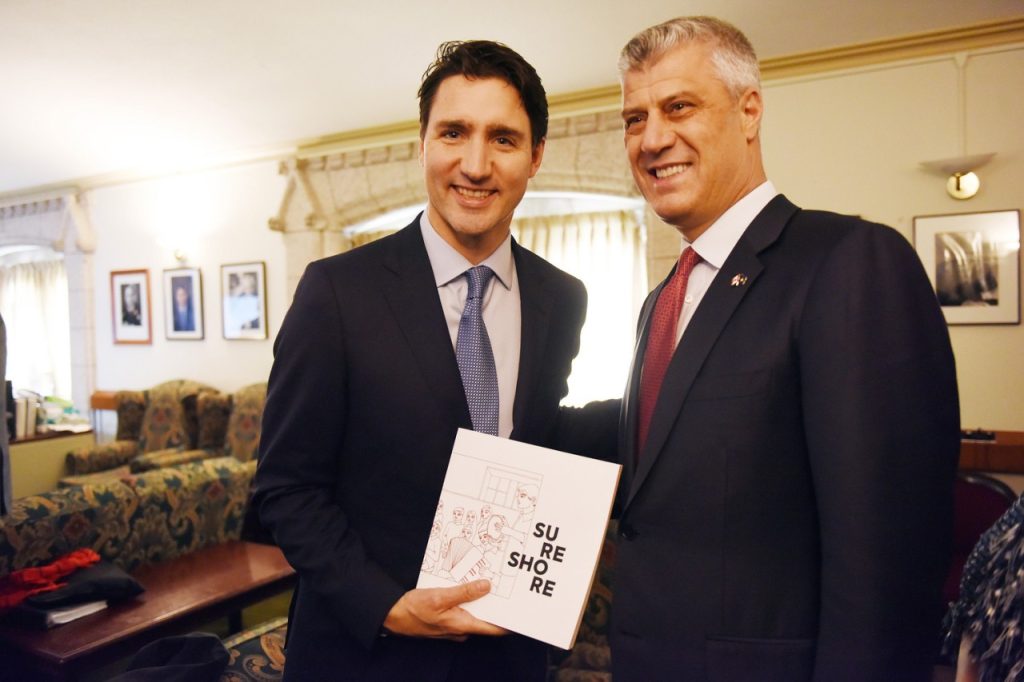
Ottawa, Canada, November 21 – The President of the Republic of Kosovo, Hashim Thaçi, met with the Prime Minister of Canada, Justin Trudeau, in the continuation of the first day of the official visit in Canada.
President Thaçi and the Canadian Minister sign the Letter of Good Intent for the Investment Protection Agreement
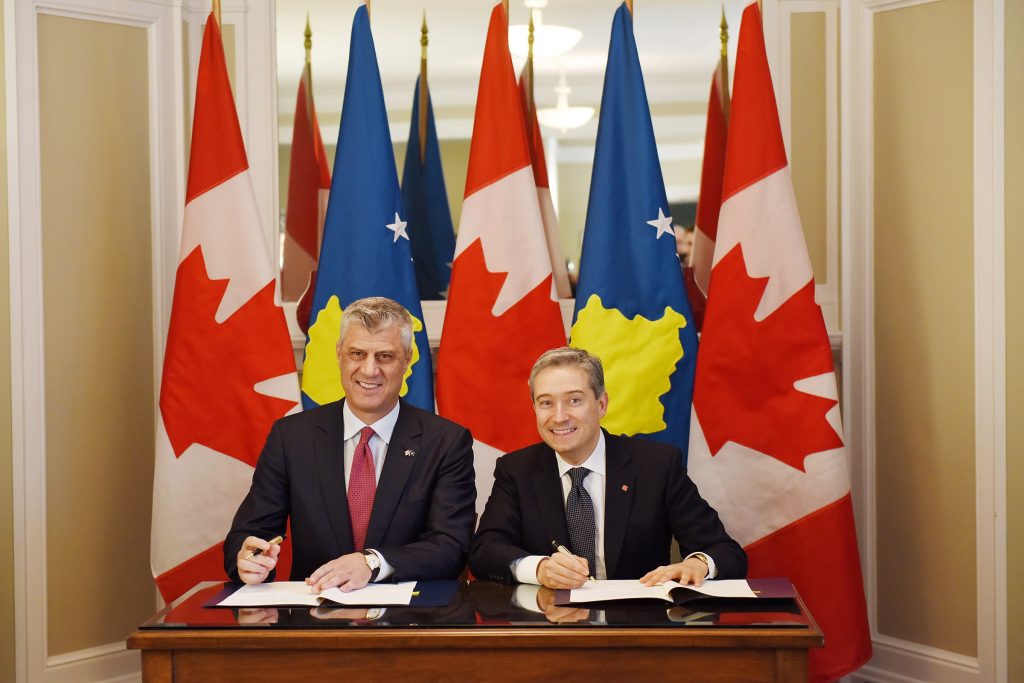
The President of the Republic of Kosovo, Hashim Thaçi, and the Minister of International Trade of Canada, François-Philippe Champagne, have pledged today that Kosovo and Canada will soon have an Investment Protection Agreement between our two countries, signing the Letter of Good Intent, which precedes this agreement.
President Thaçi’s speech to the Parliamentary Committee on Foreign Affairs in Canada
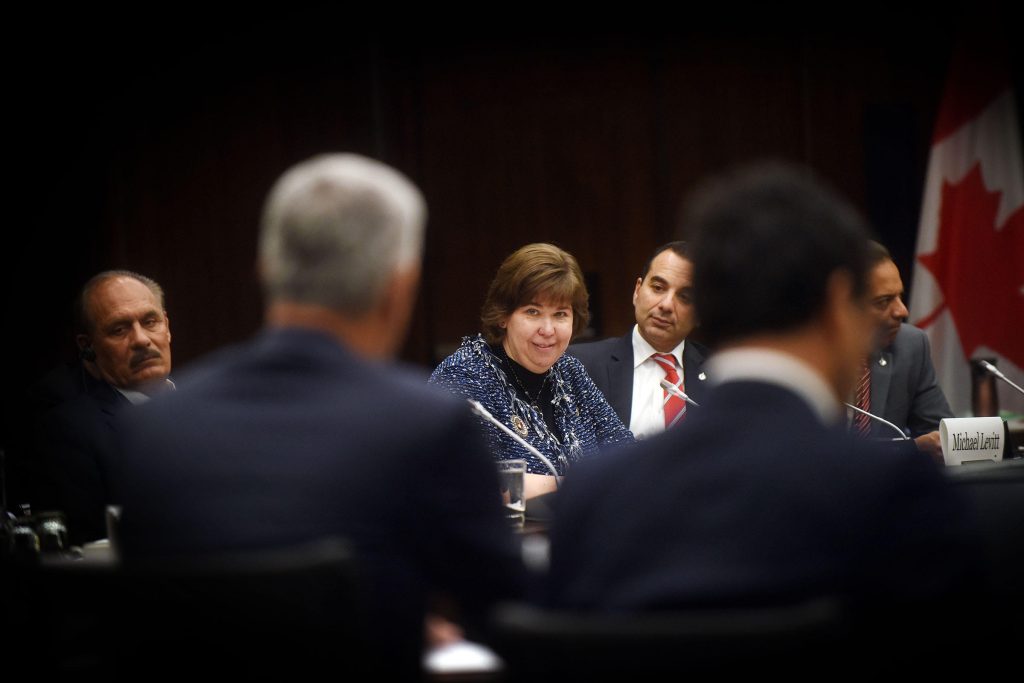
Honorable Chairman Nollt, Honorable Vice Chairmen, Mr. O-Toll and Honorable Ms. Leverdier, Honorable MPs, members of the Committee on Foreign Affairs, It is a pleasure to meet with you today and to talk about Kosovo, but also about the whole region of Southeastern Europe, about our achievements but also the challenges for building peace and reconciliation. But also about our bilateral cooperation, between Kosovo and Canada. I am glad that my visit is taking place at the time when Canada marks its 150th anniversary. Canada is a strategic partner for us with whom we share common values, principles and aspirations. As a Kosovo, we are grateful for the support Canada has provided to Kosovo for decades. Particularly it is worth to mention the acceptance of 7,000 refugees from Kosovo in 1999. I had the chance to meet some of them in Halifax, to visit the military base where most of them were expected when they arrived in Canada. It was a touching moment to remember the days of war but also a moment of joy and pride to see how well they are integrated into the Canadian society and contribute to the Canadian state and society. They are now a linking bridge between our two peoples. Canada’s support has been important even after the war, in rebuilding the country and building peace. We are grateful that Canada has been among the first countries to recognize Kosovo and continues to support Kosovo in consolidating its citizenship. Our bilateral cooperation is growing, especially in economy, with particular emphasis on the mining industry. I am glad about the opportunity that Kosovo and Canada will sign an Investment Protection Agreement between our two countries. Last month I had the honor to decorate the former Foreign Minister Aksuorthi with the Medal for Contribution to Peace and Democracy, and I am glad to see the MP Vandenbeld in the Committee, who was decorated by the Canadian Government for the contribution to peace. Honorable MPs, Let me say a few words about the past of Kosovo, about the present and especially about our aspirations for the future of Kosovo and the region of South-eastern Europe. In February we will mark the tenth anniversary of Kosovo’s independence The declaration of independence came after a long international process that sought solution for Kosovo’s international political status. This international process began in the 1990s with the United Nations Security Council resolutions condemning the violence and repression of Slobodan Miloševic’s regime. It continued with the International Rambouillet Conference in the spring of 1999, in which the international community sought a solution for Kosovo. Miloševic’s regime not only didn’t cooperate with the international community but continued the campaign of violence and repression escalating into an attempt to genocide. This forced NATO to intervene to prevent another genocide in Europe’s land. This led to the establishment of the International Administration in Kosovo. In 2005, the United Nations appointed President Ahtisaari, Nobel Peace Laureates, to seek a solution to the status of Kosovo. In a UN-led process, where, especially the United States of America, the EU and Russia have actively participated, President Ahtisaari recommended that the best solution for Kosovo is independence. In accordance with Ahtisaari’s recommendations, in February 2008, Kosovo declared the independence. Today we can freely say that there has never been a more multi-lateral and more internationally coordinated declaration of independence than in the case of Kosovo The last seal to the independence for Kosovo was given by the International Court of Justice which in August 2010 said clearly that the declaration of Kosovo’s independence was in line with international law, after Serbia had addressed the International Court of Justice with the question of whether Kosovo had violated the international law when it declared independence. Honorable MPs, Where is Kosovo today? Without having completed a decade as a state, Kosovo has signed the Stabilization and Association Agreement with the European Union, which is the first step towards building a cooperation that will ultimately bring membership to the European Union. Kosovo has been admitted to the US Congress Millennium Challenge Corporation Program and has started implementing MCC projects. Both successes have been achieved only after the achievements in comprehensive reforms in the economy, rule of law and the building of democratic institutions have been confirmed. Kosovo has been recognized by 114 countries and has joined many regional and international organizations such as the World Bank, the International Monetary Fund or the Venice Commission. In accordance with the Ahtisaari Package, we have built comprehensive governing institutions in which all communities living in Kosovo are represented. In the Kosovo Assembly with 120 seats, 20 are reserved for non-majority communities, 10 for the Serb community and 10 for other communities, to guarantee their political representation. We have installed affirmative practices in education, employment, language use in the administration or even in the public media, to guarantee education, employment and information for all. We have installed communication, dialogue as the only tool to find solutions to every issue. We promote the dialogue between religions, best represented with the Inter-Faith Conference held annually, and which brings together religious leaders, politicians, and scholars from around the world discussing the dialogue between religions. We are proud of the tolerance and coexistence between the religious communities that we have in Kosovo. This is a value that is an example for the region and beyond. We have initiated the establishment of the Truth and Reconciliation Commission as a tool for internal dialogue between ethnic communities to close the war chapter and to open the chapter of peace, dialogue, cooperation, coexistence in a multi-ethnic, democratic, comprehensive society. We have consolidated Kosovo’s statehood within, extending the sovereignty across the entire territory of Kosovo, including the northern part of Kosovo. Thanks to the dialogue and affirmative measures, today this part is also involved in Kosovo’s institutions. Elections were held under Kosovo’s laws and the elected leaders operate within Kosovo’s institutions and according to Kosovo’s laws. This is the result of the dialogue
President Thaçi meets his Canadian counterpart, they speak about the deepening of cooperation
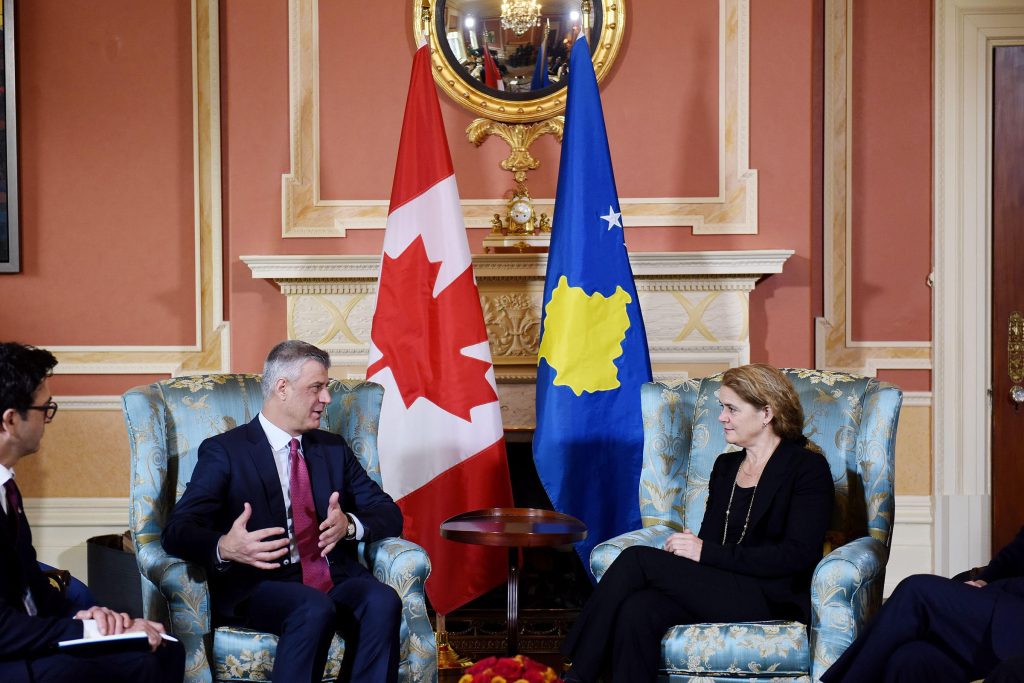
The President of the Republic of Kosovo, Hashim Thaçi, during his stay in Canada was received by his homologue, the Governor General of Canada, Julie Payette.
President Thaçi discusses with the Canadian MPs about Kosovo and the region: We are working for NATO and EU membership!
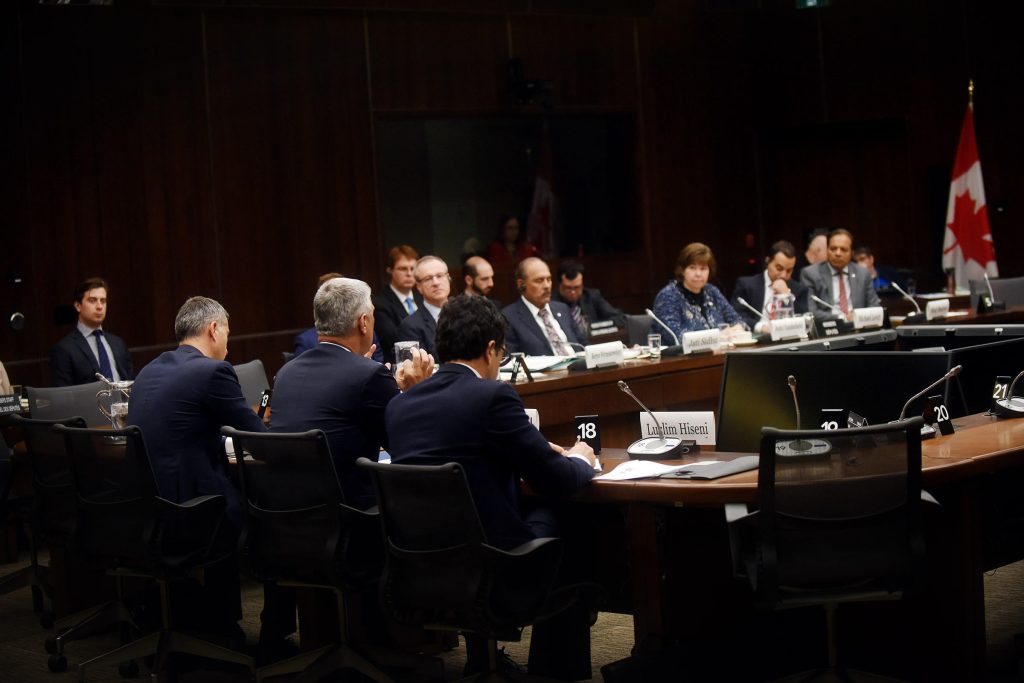
The President of the Republic of Kosovo, Hashim Thaçi, today in the Parliamentary Committee on Foreign Affairs of the Parliament in Canada, in front of the Canadian MPs, spoke about Kosovo and Southeastern Europe.
President Thaçi: Peace and dialogue are values that bring Canada and Kosovo together
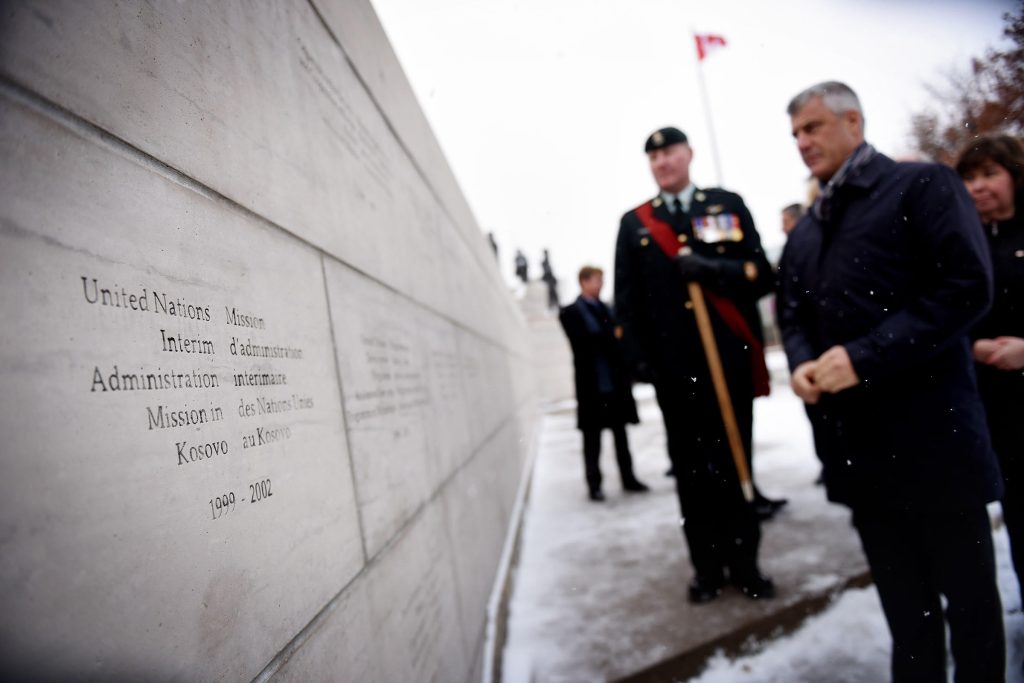
Ottawa, Canada, November 20 – The President of the Republic of Kosovo, Hashim Thaci, at the beginning of his visit to Canada, put today a wreath of flowers at the Peace and Reconciliation Monument in Ottawa.
President Thaçi: Kosovo once again proved that free and democratic elections are now a consolidated standard
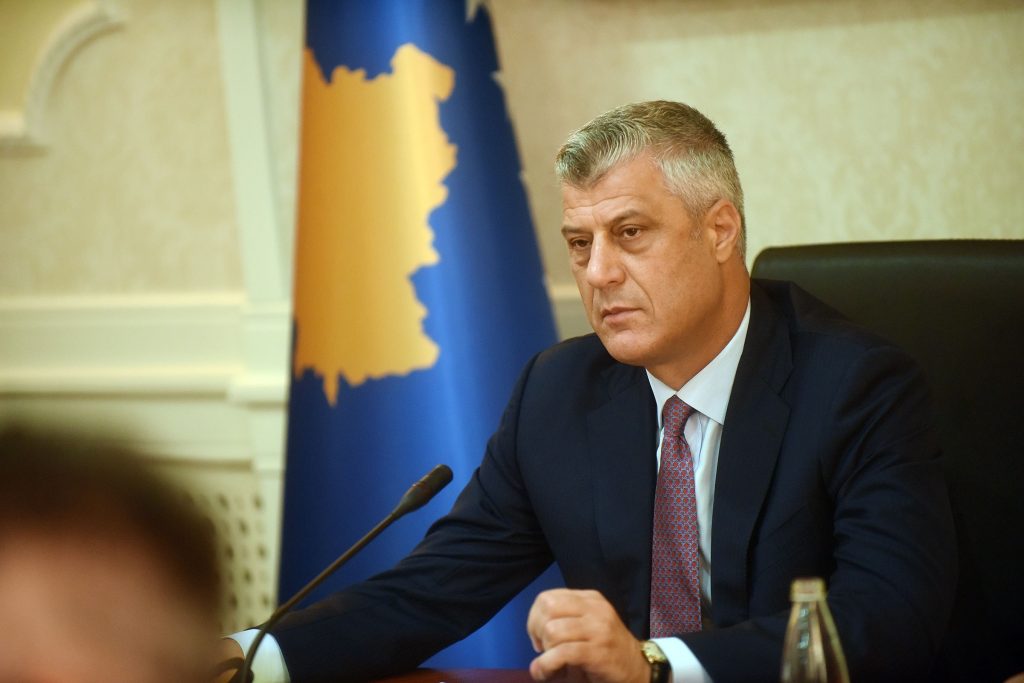
The President of the Republic of Kosovo, Hashim Thaçi, congratulates the citizens of Kosovo, the political parties, the civil society and media, all state institutions, the CEC for the organization of free and democratic elections.
President Thaçi has travelled to the Canadian capital, Ottawa
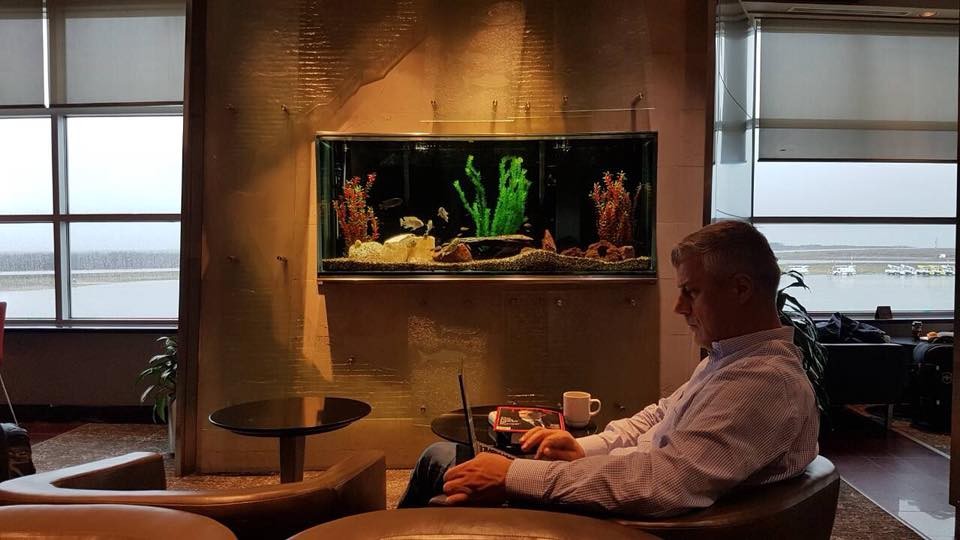
The President of the Republic of Kosovo, Hashim Thaçi, after his stay in Halifax, where he participated at the International Security Forum, travelled today to the Canadian capital, Ottawa, where he will conduct a series of meetings with representatives of the Government and Parliament of Canada.