
The President: Impunity of the Serbian genocide is selective justice
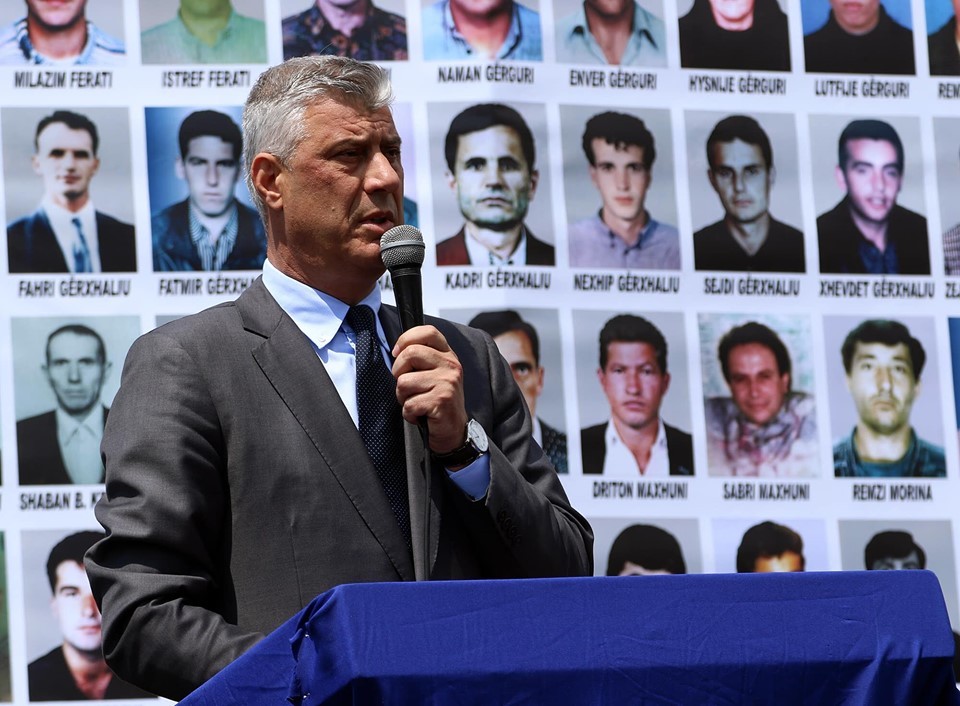
Studime- Vushtrri, May 2nd 2019- The President of the Republic of Kosovo, Hashim Thaçi, participated today the marking of the 20th anniversary of the Studime village massacre and paid his homage at the Memorial Complex of the Martyr’s cemetery.
Remarks by the President of the Republic of Kosovo, Hashim Thaçi at the Berlin Summit related to the dialogue on the normalization of relations between Kosovo and Serbia
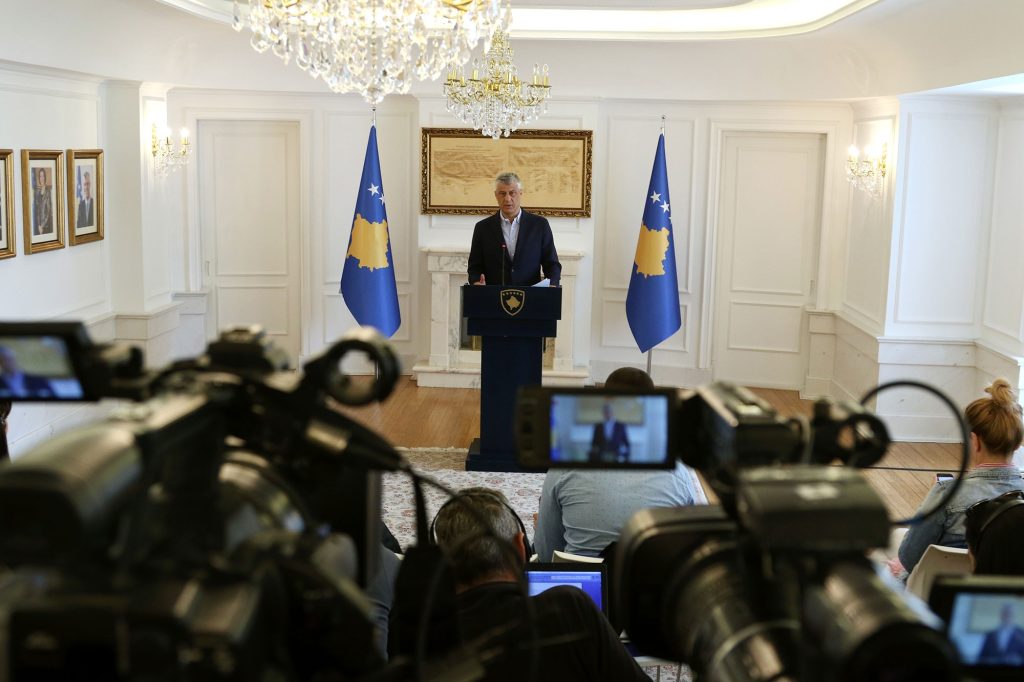
Ladies and gentlemen, Let me once again say that I can not sufficiently emphasize the importance of today’s meeting, which is occurring at a very delicate period for the region, and especially of the very tense relations between Kosovo and Serbia. Despite the fact that the process of normalizing relations between Kosovo and Serbia resembles a very difficult marathon and full of obstacles, I say that dialogue remains the only way to achieve peace and reconciliation. Moreover, the 2013 agreement and all the other agreements reached afterwards have improved the lives of citizens of both states. Unfortunately, not all the reached agreements have been fully implemented. Serbia has failed to implement the Energy and Integrated Border Management (IBM) agreement and has made it impossible to open the bridge over the Ibër River in Mitrovica, which unites the divided city and the citizens. Also, with its destructive actions, Serbia has made it impossible for Kosovo to implement in practice the Agreement for the Establishment of the Association of Serb-majority Municipalities in Kosovo in accordance with the 2013 Brussels Agreement and the Decision of the Constitutional Court of Kosovo. The Management Team for the compilation of the draft statute of the Association, which consists of representatives of the Serb community living in Kosovo, in accordance with the instructions and recommendations of Serbia, has deliberately failed to perform its work in accordance with the Agreement. Of course, Serbia continues to accuse Kosovo of not implementing this agreement in practice, but it should be clear to all that the institutions of the Republic of Kosovo are ready to implement it without any delay, but always in accordance with the Agreement and the Decision of the Constitutional Court of Kosovo. I believe that it is clear to all of you why Serbia doesn’t want the Association to be established as foreseen by the Agreement and the Decision of the Constitutional Court. The goal is clear, in the northern part of Kosovo, Serbia wants to establish an Association of Serbian Municipalities with executive powers, the same as the Republika Srpska model in Bosnia. This can not happen in Kosovo and today I once again reiterate that there won’t be an Association with executive powers or a level of third power. Now let me return to the current situation about the dialogue and the possibilities of reaching a final agreement. We are all witnesses that the dialogue is currently blocked. There are several factors that have brought this hopeless situation, but I’m just mentioning some of them. Firstly, Serbia unilaterally conditioned the continuation of the dialogue with the abolition of the tax on Serbian products imposed by Kosovo. This action is unacceptable and contrary to the leading principle of dialogue that has been respected since 2011, which implies that the dialogue is unconditional. The imposition of the tax was an indispensable and legitimate decision in response to Serbia’s repeated and documented violations of CEFTA. As such, it remains in effect. Secondly, let me say that our joint efforts to reach a comprehensive agreement have been undermined and opposed incomprehensibly in some ways. Despite the will of the mediator of the dialogue, Ms. Federica Mogherini, and my willingness and the willingness of President Vućiq to work seriously towards a comprehensive final agreement, support lacked both internationally and regionally. The international factor, specifically, the Quint states, the USA, England, Germany, France and Italy have not shown unity and support for our efforts for a comprehensive agreement. This disunity has had very negative reflections on the political spectrum in Kosovo and as a result we have had controversial positions and great difficulties in establishing the Comprehensive Negotiating Team in Kosovo. With all the greatest respect for you, Chancellor Merkel, President Macron, I am skeptical that a comprehensive final agreement can be reached if the Quint states aren’t united and if they do not speak with one voice. Moreover, you all know that the agreement is impossible without the decisive role of the USA. Thirdly, the neighboring states in the region, with any small exception, haven’t proved to be helpful at all to our efforts. Thus, while in our bilateral meetings they have supported our efforts for an agreement, the bitter truth is that in the meetings they have held with the Quint states, including Germany and France, the states from the region have expressed contradiction (in my groundless view) towards reaching a comprehensive agreement. The fundamental opposition of some Quint states against our efforts for comprehensive agreement (and of the aforementioned states from the Western Balkans) has been justified and focused on a single issue, the one of the border demarcation between Kosovo and Serbia, or in some cases of border correction. This is done intentionally, to increase fears that we are allegedly trying to change the boundaries of the Balkans, that we are allegedly want borders along ethnic lines, etc. Political opponents in Kosovo have accused me of allegedly being pro the partition of Kosovo, and some Western diplomats for allegedly creating new ethnic boundaries in the Balkans. These claims have been and are completely wrong. To the ones who have hurried to attack me so low by hiding behind some misguided principles I say that if today we are afraid of the truth and behave as if being principled without offering a solution, preferring to freeze the conflict instead of solving it tomorrow we can face extremely destructive options that lead to the separation or creation of a new Serb Republic in the north of Kosovo. We have worked on a comprehensive agreement which among the many points I will address should also have a special point for the demarcation of the border, which should be done by experts of this field. I am sure that regardless of the fact when and how an agreement will be reached between Kosovo and Serbia, the demarcation of the border between the two states is simply inevitable. We know this from our experience with Montenegro, but we also know from
Remarks by the President of Kosovo at the Berlin Summit on regional reconciliation and cooperation
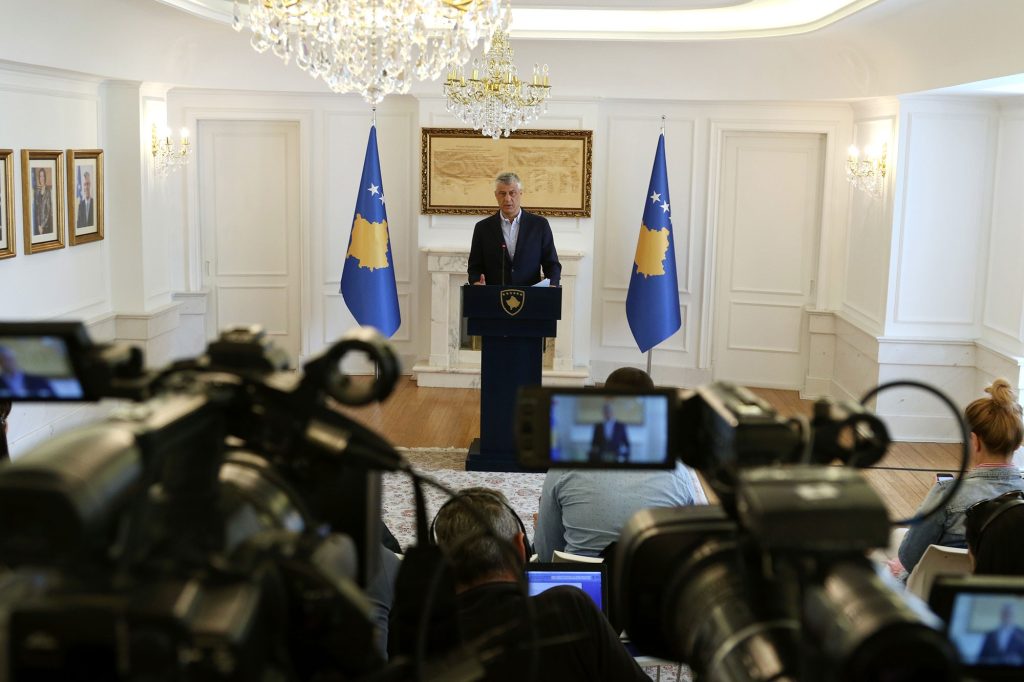
Ladies and gentlemen, At the outset, I must point out that despite the fact that 20 years have passed since the end of the wars in the Western Balkans, full interethnic and inter-state reconciliation still seems distant, despite the progress made. The same situation is reflected when it comes to regional cooperation, despite numerous initiatives undertaken so far, including the Berlin process. The EU integration process is almost completely blocked. The European perspective for Kosovo remains only a good phrase to the ears which continues to be repeated, but nothing more. Today’s reality in the Western Balkans does not match at all with our expectations and perhaps even those of the EU. Despite the fact that Kosovo’s declaration of independence in 2008 has ended the breakup process of former Yugoslavia, peace in our region still remains fragile. The current instability in Kosovo’s relations with neighboring countries in the region is firstly the result of Serbia’s non-recognition and hostile behavior, and secondly, the non- recognition of the independence by Bosnia and Herzegovina. Serbia has consistently continued to undermine and violate Kosovo’s state sovereignty. Strangely, the hostile and anti-European behavior has not restrained Serbia’s journey towards EU membership. The non-recognition of Kosovo’s independence from Serbia is causing major problems for the Euro-Atlantic journey of Kosovo. This situation has enabled the five EU member states not to recognize Kosovo. As a result, Kosovo is legally and practically unable to take concrete steps to join the EU and NATO. As a conclusion, Kosovo’s relations with Serbia are constantly aggravated, there are many barriers to freedom of movement for citizens and goods. The dialogue commenced in 2011, despite tangible results, is now blocked by Serbia, which has conditioned its continuation with the abolition of the tax. The conditioning of the dialogue has not dared to happen in any circumstances, because the dialogue can not be conditioned by either side. This has been the unwritten leading principle since the beginning of this process. On the other hand, more or less, due to Serbia’s negative impact, Kosovo’s relations with Bosnia and Herzegovina are at the lowest possible level. There is no free movement for the citizens of both countries, and consequently neither for goods. There is a really paradoxical situation, the EU has lifted the visas for the citizens of Bosnia and Herzegovina, while the latter still maintains the visa regime for Kosovars. It can easily happen that the EU will lift visas for Kosovo citizens, while Bosnia and Herzegovina will continue to maintain them. Ladies and gentlemen, Despite this tense reality, there has certainly been some progress in relation to other neighboring countries in the region. First of all, it is very important that Kosovo and Montenegro have managed to ratify the inter-state agreement for marking the border line/demarcation. This issue has been essential to establishing good mutual relations. Moreover, for Kosovo, the demarcation of the border with Montenegro, has been the last criterion for visa liberalization from the EU. But for our bad luck, the current reality testifies that this was just a deceptive promise. Kosovo unfairly remains the most isolated country in Europe. The European Commission had recommended visa liberalization in May 2016. I don’t understand why Kosovo’s citizens who are the most pro-European people in the region are discriminated in this way. North Macedonia is also a neighboring country with which we have unhindered cooperation, movement of people and goods. We have no open issues and have welcomed the Prespa agreement and are supportive for NATO and EU membership. Whereas, the relation between Kosovo and Albania is self-evident. We are brothers and as two independent states, we want to unite under the EU and NATO common umbrella. Slovenia and Croatia are Kosovo’s friend states in our region. Bilateral relations and economic cooperation are at a very satisfactory level. We just require that these two states advocate and support Kosovo and other countries in the region much more in order to accelerate the fulfillment of our aspirations for EU and NATO membership. Ladies and gentlemen, In such a situation of our neighborly relations, many good initiatives that have emerged from the Berlin Process have remained unrealized. – Progress towards the establishment of the regional economic zone, free trade, connectivity, and above all reconciliation, will remain impossible or just minimal, as long as Serbia and Bosnia and Herzegovina do not recognize Kosovo’s independence – As long as this does not happen, the influence of third parties in our region, respectively the influence of Russia and China will be continuous. This bad situation in our region can not be overcome only with abstract statements and promises. Bold decisions are needed by the countries of the region that will not occur for as long as there are no bold and strategic decisions by the EU and its member states. Germany and France have the opportunity to take leadership for these bold decisions, but whether they will do so or not, is up to their will. Thank you for your attention!
Remarks by the President of the Republic of Kosovo, Hashim Thaçi at the Berlin Summit related to the dialogue on the normalization of relations between Kosovo and Serbia
Ladies and gentlemen, Let me once again say that I can not sufficiently emphasize the importance of today’s meeting, which is occurring at a very delicate period for the region, and especially of the very tense relations between Kosovo and Serbia. Despite the fact that the process of normalizing relations between Kosovo and Serbia resembles a very difficult marathon and full of obstacles, I say that dialogue remains the only way to achieve peace and reconciliation. Moreover, the 2013 agreement and all the other agreements reached afterwards have improved the lives of citizens of both states. Unfortunately, not all the reached agreements have been fully implemented. Serbia has failed to implement the Energy and Integrated Border Management (IBM) agreement and has made it impossible to open the bridge over the Ibër River in Mitrovica, which unites the divided city and the citizens. Also, with its destructive actions, Serbia has made it impossible for Kosovo to implement in practice the Agreement for the Establishment of the Association of Serb-majority Municipalities in Kosovo in accordance with the 2013 Brussels Agreement and the Decision of the Constitutional Court of Kosovo. The Management Team for the compilation of the draft statute of the Association, which consists of representatives of the Serb community living in Kosovo, in accordance with the instructions and recommendations of Serbia, has deliberately failed to perform its work in accordance with the Agreement. Of course, Serbia continues to accuse Kosovo of not implementing this agreement in practice, but it should be clear to all that the institutions of the Republic of Kosovo are ready to implement it without any delay, but always in accordance with the Agreement and the Decision of the Constitutional Court of Kosovo. I believe that it is clear to all of you why Serbia doesn’t want the Association to be established as foreseen by the Agreement and the Decision of the Constitutional Court. The goal is clear, in the northern part of Kosovo, Serbia wants to establish an Association of Serbian Municipalities with executive powers, the same as the Republika Srpska model in Bosnia. This can not happen in Kosovo and today I once again reiterate that there won’t be an Association with executive powers or a level of third power. Now let me return to the current situation about the dialogue and the possibilities of reaching a final agreement. We are all witnesses that the dialogue is currently blocked. There are several factors that have brought this hopeless situation, but I’m just mentioning some of them. Firstly, Serbia unilaterally conditioned the continuation of the dialogue with the abolition of the tax on Serbian products imposed by Kosovo. This action is unacceptable and contrary to the leading principle of dialogue that has been respected since 2011, which implies that the dialogue is unconditional. The imposition of the tax was an indispensable and legitimate decision in response to Serbia’s repeated and documented violations of CEFTA. As such, it remains in effect. Secondly, let me say that our joint efforts to reach a comprehensive agreement have been undermined and opposed incomprehensibly in some ways. Despite the will of the mediator of the dialogue, Ms. Federica Mogherini, and my willingness and the willingness of President Vućiq to work seriously towards a comprehensive final agreement, support lacked both internationally and regionally. The international factor, specifically, the Quint states, the USA, England, Germany, France and Italy have not shown unity and support for our efforts for a comprehensive agreement. This disunity has had very negative reflections on the political spectrum in Kosovo and as a result we have had controversial positions and great difficulties in establishing the Comprehensive Negotiating Team in Kosovo. With all the greatest respect for you, Chancellor Merkel, President Macron, I am skeptical that a comprehensive final agreement can be reached if the Quint states aren’t united and if they do not speak with one voice. Moreover, you all know that the agreement is impossible without the decisive role of the USA. Thirdly, the neighboring states in the region, with any small exception, haven’t proved to be helpful at all to our efforts. Thus, while in our bilateral meetings they have supported our efforts for an agreement, the bitter truth is that in the meetings they have held with the Quint states, including Germany and France, the states from the region have expressed contradiction (in my groundless view) towards reaching a comprehensive agreement. The fundamental opposition of some Quint states against our efforts for comprehensive agreement (and of the aforementioned states from the Western Balkans) has been justified and focused on a single issue, the one of the border demarcation between Kosovo and Serbia, or in some cases of border correction. This is done intentionally, to increase fears that we are allegedly trying to change the boundaries of the Balkans, that we are allegedly want borders along ethnic lines, etc. Political opponents in Kosovo have accused me of allegedly being pro the partition of Kosovo, and some Western diplomats for allegedly creating new ethnic boundaries in the Balkans. These claims have been and are completely wrong. To the ones who have hurried to attack me so low by hiding behind some misguided principles I say that if today we are afraid of the truth and behave as if being principled without offering a solution, preferring to freeze the conflict instead of solving it tomorrow we can face extremely destructive options that lead to the separation or creation of a new Serb Republic in the north of Kosovo. We have worked on a comprehensive agreement which among the many points I will address should also have a special point for the demarcation of the border, which should be done by experts of this field. I am sure that regardless of the fact when and how an agreement will be reached between Kosovo and Serbia, the demarcation of the border between the two states is simply inevitable. We know this from our experience with Montenegro, but we also know from
Remarks by the President of Kosovo at the Berlin Summit on regional reconciliation and cooperation
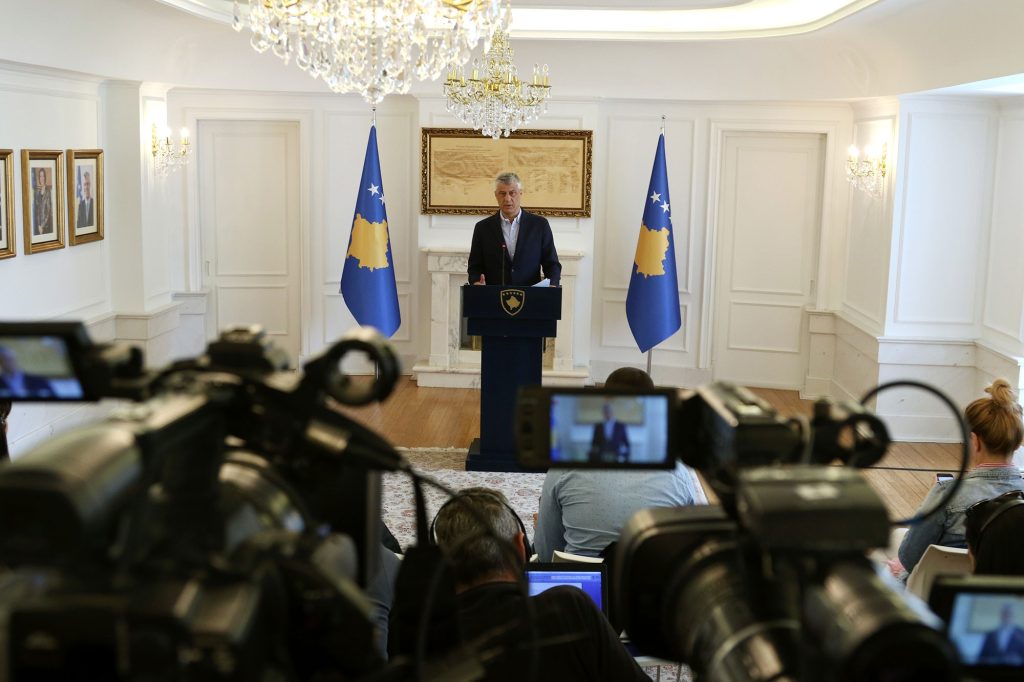
Ladies and gentlemen, At the outset, I must point out that despite the fact that 20 years have passed since the end of the wars in the Western Balkans, full interethnic and inter-state reconciliation still seems distant, despite the progress made. The same situation is reflected when it comes to regional cooperation, despite numerous initiatives undertaken so far, including the Berlin process. The EU integration process is almost completely blocked. The European perspective for Kosovo remains only a good phrase to the ears which continues to be repeated, but nothing more. Today’s reality in the Western Balkans does not match at all with our expectations and perhaps even those of the EU. Despite the fact that Kosovo’s declaration of independence in 2008 has ended the breakup process of former Yugoslavia, peace in our region still remains fragile. The current instability in Kosovo’s relations with neighboring countries in the region is firstly the result of Serbia’s non-recognition and hostile behavior, and secondly, the non- recognition of the independence by Bosnia and Herzegovina. Serbia has consistently continued to undermine and violate Kosovo’s state sovereignty. Strangely, the hostile and anti-European behavior has not restrained Serbia’s journey towards EU membership. The non-recognition of Kosovo’s independence from Serbia is causing major problems for the Euro-Atlantic journey of Kosovo. This situation has enabled the five EU member states not to recognize Kosovo. As a result, Kosovo is legally and practically unable to take concrete steps to join the EU and NATO. As a conclusion, Kosovo’s relations with Serbia are constantly aggravated, there are many barriers to freedom of movement for citizens and goods. The dialogue commenced in 2011, despite tangible results, is now blocked by Serbia, which has conditioned its continuation with the abolition of the tax. The conditioning of the dialogue has not dared to happen in any circumstances, because the dialogue can not be conditioned by either side. This has been the unwritten leading principle since the beginning of this process. On the other hand, more or less, due to Serbia’s negative impact, Kosovo’s relations with Bosnia and Herzegovina are at the lowest possible level. There is no free movement for the citizens of both countries, and consequently neither for goods. There is a really paradoxical situation, the EU has lifted the visas for the citizens of Bosnia and Herzegovina, while the latter still maintains the visa regime for Kosovars. It can easily happen that the EU will lift visas for Kosovo citizens, while Bosnia and Herzegovina will continue to maintain them. Ladies and gentlemen, Despite this tense reality, there has certainly been some progress in relation to other neighboring countries in the region. First of all, it is very important that Kosovo and Montenegro have managed to ratify the inter-state agreement for marking the border line/demarcation. This issue has been essential to establishing good mutual relations. Moreover, for Kosovo, the demarcation of the border with Montenegro, has been the last criterion for visa liberalization from the EU. But for our bad luck, the current reality testifies that this was just a deceptive promise. Kosovo unfairly remains the most isolated country in Europe. The European Commission had recommended visa liberalization in May 2016. I don’t understand why Kosovo’s citizens who are the most pro-European people in the region are discriminated in this way. North Macedonia is also a neighboring country with which we have unhindered cooperation, movement of people and goods. We have no open issues and have welcomed the Prespa agreement and are supportive for NATO and EU membership. Whereas, the relation between Kosovo and Albania is self-evident. We are brothers and as two independent states, we want to unite under the EU and NATO common umbrella. Slovenia and Croatia are Kosovo’s friend states in our region. Bilateral relations and economic cooperation are at a very satisfactory level. We just require that these two states advocate and support Kosovo and other countries in the region much more in order to accelerate the fulfillment of our aspirations for EU and NATO membership. Ladies and gentlemen, In such a situation of our neighborly relations, many good initiatives that have emerged from the Berlin Process have remained unrealized. – Progress towards the establishment of the regional economic zone, free trade, connectivity, and above all reconciliation, will remain impossible or just minimal, as long as Serbia and Bosnia and Herzegovina do not recognize Kosovo’s independence – As long as this does not happen, the influence of third parties in our region, respectively the influence of Russia and China will be continuous. This bad situation in our region can not be overcome only with abstract statements and promises. Bold decisions are needed by the countries of the region that will not occur for as long as there are no bold and strategic decisions by the EU and its member states. Germany and France have the opportunity to take leadership for these bold decisions, but whether they will do so or not, is up to their will. Thank you for your attention!
President Thaçi: The fate of the missing people to be brought to light urgently
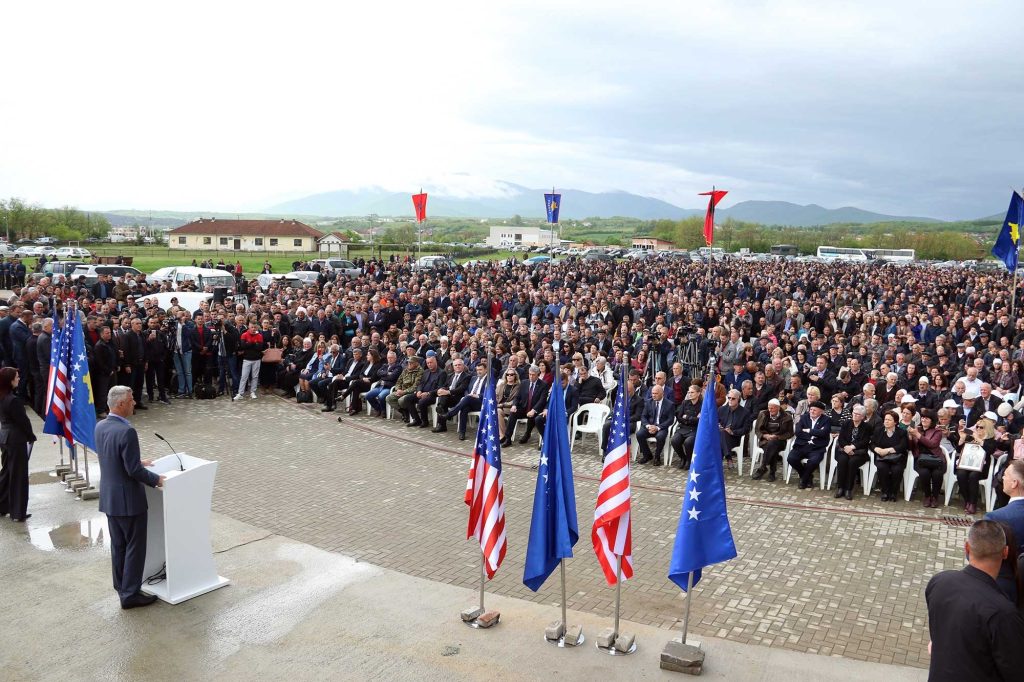
Meje, April 27th 2019 – President of the Republic of Kosovo, Hashim Thaçi, participated today at the marking of the Day of the Missing held at Meje village, Gjakova municipality.
President Thaçi decorated the martyrs of the Battle of Majdan and Melenica with the Order “Hero of Kosovo”
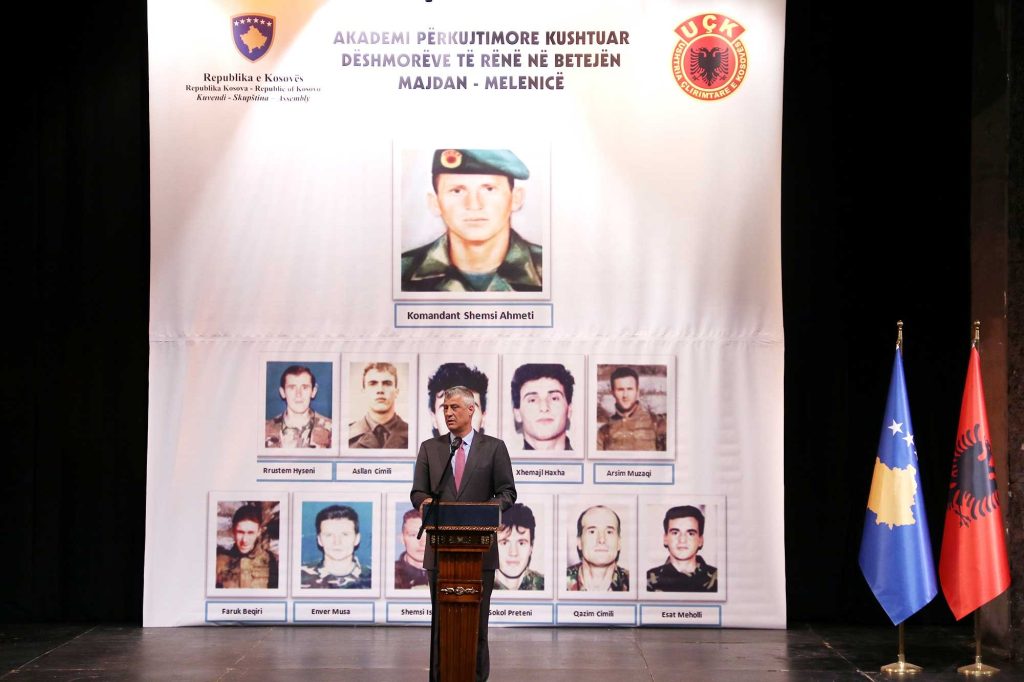
Prishtina, April 26, 2019 – The President of the Republic of Kosovo, Hashim Thaçi, attended today the Memorial Academy for the fallen martyrs in the Battle of Majdan and Melenica.
The Preparatory Team has consultations with media representatives
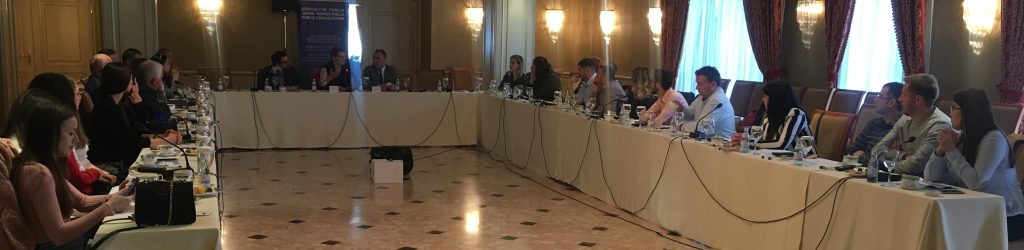
April 24, 2019, Prishtina – The Preparatory Team for the Establishment of the Truth and Reconciliation Commission held public consultations with the representatives of various media from all regions of Kosovo.
The Preparatory Team, in public consultation with legal professionals
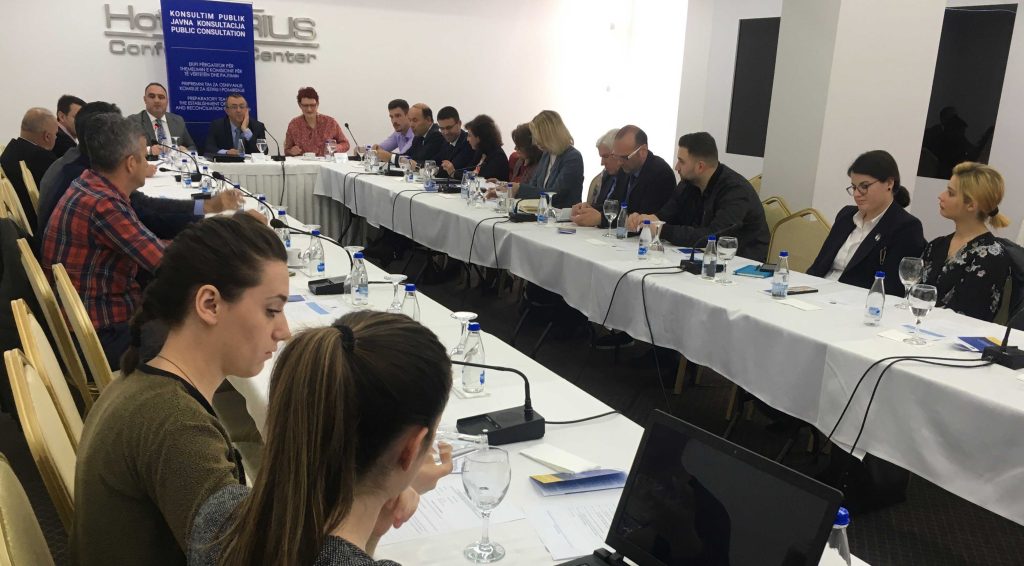
April 19, 2019, Prishtina – The Preparatory Team for the Establishment of the Truth and Reconciliation Commission held a public consultation with legal professionals, judges, prosecutors, lawyers and other public officials.
The speech of the President of the Republic of Kosovo, Hashim Thaçi, at the Academy for the 20th Anniversary of the founding of the “Atlantiku” battalion
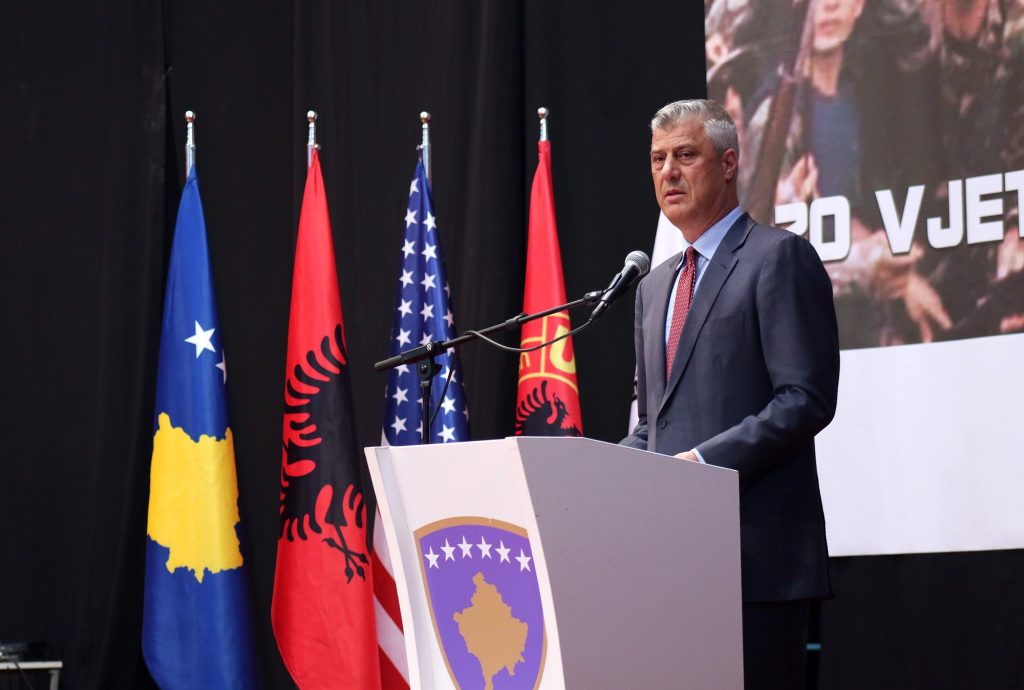
Ladies and Gentlemen, The “Atlantiku” battalion is the most representative synthesis of the cyclical circle or the four phases of Albanian-American relations with the homeland and the United States of America. Your ancestors, and you as well, went to the United States of America. To the great homeland of freedom and democracy. The Albanians of America have played an extraordinary and historic role in affirming the Kosovo issue. During the most difficult moments for Kosovo, your reaction was completely natural because you knew the deep meaning of FREEDOM. The “Atlantiku” battalion is the clearest indicator of the political and military history of Albanians, so you responded the best to the call “the Homeland at Risk, the Birthplace Calls”. You, from the ultimate welfare, came to war. You are the BATTLE and the FRONT of the liberation war. In the framework of the “Atlantiku” battalion you directly fought the invading Serbian military forces. You completed your mission for the homeland with your heads held high. You came as volunteers, became extraordinary fighters, but above all, became the victors of the war for the liberation of Kosovo. By defeating the Serbian forces, along with NATO’s assistance, you accomplished the highest national, patriotic and political mission. You made the dream of all generations a reality. You entered into Kosovo with the air of freedom. And, at the end of the fourth phase, after giving meaning to freedom, through war and sacrifice you returned to the United States of America, to your families, to your profession, work and business. Like warriors you put on the uniforms and took the weapons in your hand in the war for freedom. After the victory, you took off your uniform and returned to life This is what people do when having a philosophical dimension of freedom. Ladies and gentlemen, Kosovo is entering the 20th Anniversary of liberation. The more time passes, the value of the liberation war will increase even more Your children and the children of your children will be proud of you, because you didn’t allow Kosovo’s servitude to continue endlessly. 2019 has been declared the year of NATO in Kosovo. We are eternally grateful to the United States of America, NATO and the EU states for what they did for the freedom, independence and establishment of Kosovo. We are eternally grateful and will bow down with respect before the brothers Bytyçi, the heroes of the “Atlantiku” battalion, the heroes of Kosovo. We wish you a peaceful life and endless happiness with your families You have been and will remain the pride of the nation!