
President Thaçi met with the Austrian Chancellor Kurz, Commissioner Hahn and President Vucic
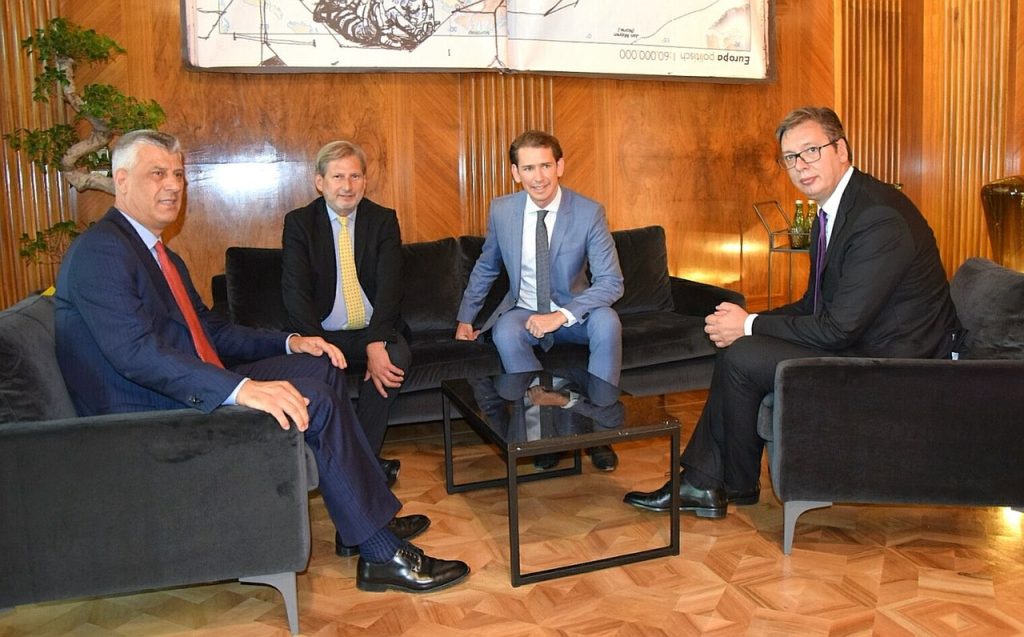
Vienna, August 26th – President of the Republic of Kosovo, Hashim Thaçi, had a joint meeting with the Chancellor of Austria Sebastian Kurtz, EU Enlargement Commissioner Johannes Hahn and with the President of Serbia, Aleksandar Vucic.
The speech of the President of the Republic of Kosovo, Hashim Thaçi, at “New perspectives for EU’s enlargement” conference, held at the European Forum in Alpbach
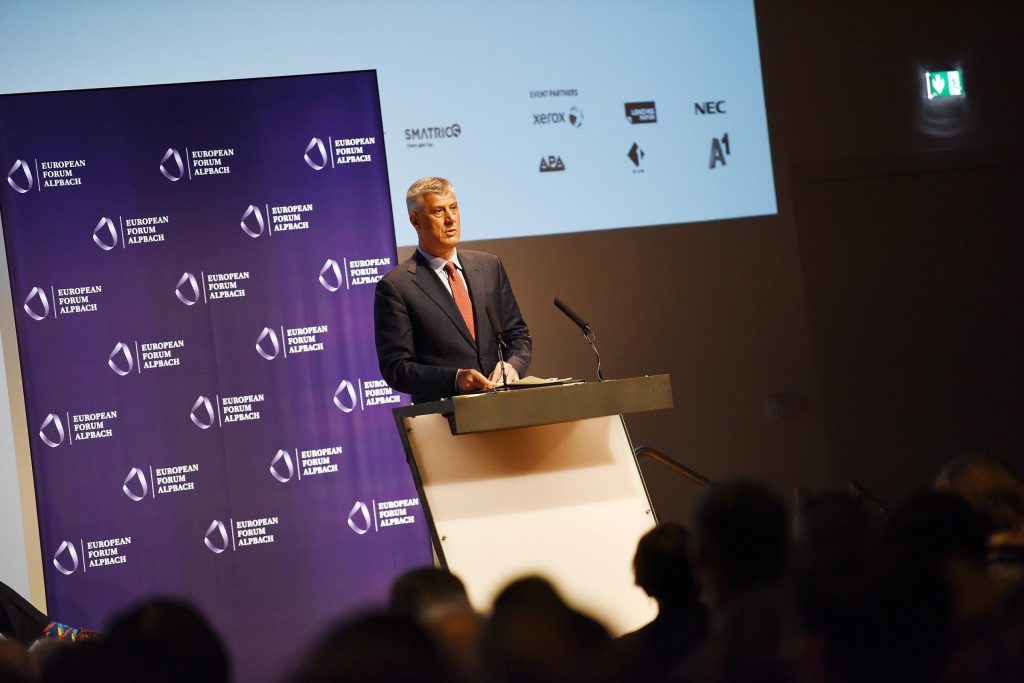
Good evening, Ladies and gentlemen, I thank you for the invitation and for selecting the important topic on EU enlargement in the Western Balkans for this session. We all agree, the more the region progresses towards the goal of EU membership, the better it is for us all because it simply means more stability, peace, regional cooperation, more foreign investment and beter life. Therefore, a well-implemented enlargement policy has the potential to make the EU itself stronger and more cohesive. The need to overcome conflicts, disputes, and resolution of bilateral issues is at the heart of the recent European Commission strategy. EU integration, and the resolution of bilateral issues and disputes between states in the Western Balkans are closely interlinked. About twenty years after the end of the wars in the Western Balkans, all our states are making concrete progress towards EU membership. When it comes to the sectorial technical reforms, there may be different levels of progress. But, looking at the whole picture, we are all at a more or less similar level of development and face more or less similar challenges in terms of democracy, rule of law and economy. The desire to join the European Union is still great in our region and I urge the EU to take advantage of this momentum to bring the region closer. Just look at and analyse the positive developments in our region recently: -the name issue agreement between Macedonia and Greece; -the completion of the border demarcation ratification between Kosovo and Montenegro; -Albania's achievements in addressing issues related to reforms in the area of ​​rule of law and the (conditional) promise of opening negotiations with both Albania and Macedonia next summer; – ongoing dialogue between Kosovo and Serbia and entering a final stage towards a final agreement on normalization of relations and reconciliation. All this happened because European integration is the foundation and ultimate goal of the region. That is why I think it is important that all Western Balkan countries should make harmonized steps towards EU membership and that the EU does not allow any country to stagnate due to bilateral disputes or internal problems. All Western Balkans 6 are committed to implement profound political and economic reforms and to harmonise our laws, including economic reforms to strengthen public finances and macroeconomic stability, improve co-operation in internal affairs and security to prevent illegal migration, and to share the burden of refugees. However, we must also know that the context in which our region is working towards EU integration is not easy. The EU’s economic crisis, migration crisis and the Brexitreferendum affected and continue to affect the commitment to the European perspective of the Western Balkans. In addition to this, there are other factors eager to extend their negative influence in the Western Balkans. Ladies and gentleman, Now we have officially launched the final phase of the Dialogue on Normalization of Relations between Kosovo and Serbia led by the High Representative, Federica Mogherini. Me and President Vucic have been invited by Federica Mogherini to attend the third meeting of this final stage on September 7. Let me stress that Kosovo is determined to reach a binding legal agreement with Serbia. The time to do this is now, and we have a short window of opportunity. It's not easy at all, it’s very difficult. That’s why everyone has to be behind it. It is not just a matter of building an internal consensus on this agreement, but we need support from all those who want to see the Western Balkans in the EU. I am willing to do so and I am working hard to achieve this goal. That’s why, we have decided to explore every possible option, including the border correction in order to make efforts to reach the deal. Countries of our region, EU member states or other countries in the world, should not oppose or be afraid of a potential peaceful agreement between Kosovo and Serbia, even if such a deal may imply border correction. I reassure everyone, that a potential agreement between Kosovo and Serbia under this scenario, will not be along the ethnic lines. Kosovo will remain a multi-ethnic society and will continue to uphold the highest standards in terms of the protection of community rights. The same principle will be valid for Serbia also. Because the ultimate peace between Kosovo and Serbia, the mutual recognition, will have positive reflections for the whole region and beyond. Perhaps this potential peaceful agreement is the single largest contributor for the realisation of the EU enlargement agenda of the Western Balkans.
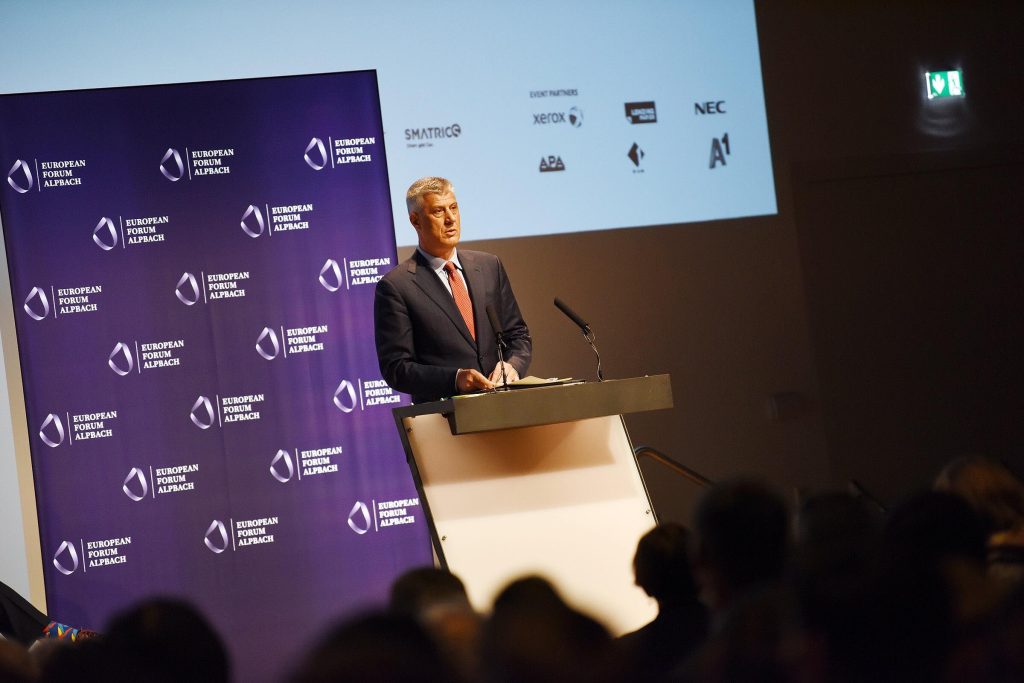
The speech of the President of the Republic of Kosovo, Hashim Thaçi, at “New perspectives for EU’s enlargement” conference, held at the European Forum in Alpbach
Good evening, Ladies and gentlemen, I thank you for the invitation and for selecting the important topic on EU enlargement in the Western Balkans for this session. We all agree, the more the region progresses towards the goal of EU membership, the better it is for us all because it simply means more stability, peace, regional cooperation, more foreign investment and beter life. Therefore, a well-implemented enlargement policy has the potential to make the EU itself stronger and more cohesive. The need to overcome conflicts, disputes, and resolution of bilateral issues is at the heart of the recent European Commission strategy. EU integration, and the resolution of bilateral issues and disputes between states in the Western Balkans are closely interlinked. About twenty years after the end of the wars in the Western Balkans, all our states are making concrete progress towards EU membership. When it comes to the sectorial technical reforms, there may be different levels of progress. But, looking at the whole picture, we are all at a more or less similar level of development and face more or less similar challenges in terms of democracy, rule of law and economy. The desire to join the European Union is still great in our region and I urge the EU to take advantage of this momentum to bring the region closer. Just look at and analyse the positive developments in our region recently: -the name issue agreement between Macedonia and Greece; -the completion of the border demarcation ratification between Kosovo and Montenegro; -Albania's achievements in addressing issues related to reforms in the area of ​​rule of law and the (conditional) promise of opening negotiations with both Albania and Macedonia next summer; – ongoing dialogue between Kosovo and Serbia and entering a final stage towards a final agreement on normalization of relations and reconciliation. All this happened because European integration is the foundation and ultimate goal of the region. That is why I think it is important that all Western Balkan countries should make harmonized steps towards EU membership and that the EU does not allow any country to stagnate due to bilateral disputes or internal problems. All Western Balkans 6 are committed to implement profound political and economic reforms and to harmonise our laws, including economic reforms to strengthen public finances and macroeconomic stability, improve co-operation in internal affairs and security to prevent illegal migration, and to share the burden of refugees. However, we must also know that the context in which our region is working towards EU integration is not easy. The EU’s economic crisis, migration crisis and the Brexitreferendum affected and continue to affect the commitment to the European perspective of the Western Balkans. In addition to this, there are other factors eager to extend their negative influence in the Western Balkans. Ladies and gentleman, Now we have officially launched the final phase of the Dialogue on Normalization of Relations between Kosovo and Serbia led by the High Representative, Federica Mogherini. Me and President Vucic have been invited by Federica Mogherini to attend the third meeting of this final stage on September 7. Let me stress that Kosovo is determined to reach a binding legal agreement with Serbia. The time to do this is now, and we have a short window of opportunity. It's not easy at all, it’s very difficult. That’s why everyone has to be behind it. It is not just a matter of building an internal consensus on this agreement, but we need support from all those who want to see the Western Balkans in the EU. I am willing to do so and I am working hard to achieve this goal. That’s why, we have decided to explore every possible option, including the border correction in order to make efforts to reach the deal. Countries of our region, EU member states or other countries in the world, should not oppose or be afraid of a potential peaceful agreement between Kosovo and Serbia, even if such a deal may imply border correction. I reassure everyone, that a potential agreement between Kosovo and Serbia under this scenario, will not be along the ethnic lines. Kosovo will remain a multi-ethnic society and will continue to uphold the highest standards in terms of the protection of community rights. The same principle will be valid for Serbia also. Because the ultimate peace between Kosovo and Serbia, the mutual recognition, will have positive reflections for the whole region and beyond. Perhaps this potential peaceful agreement is the single largest contributor for the realisation of the EU enlargement agenda of the Western Balkans.
President Thaçi travelled to Austria to attend the “Alpbach” Forum
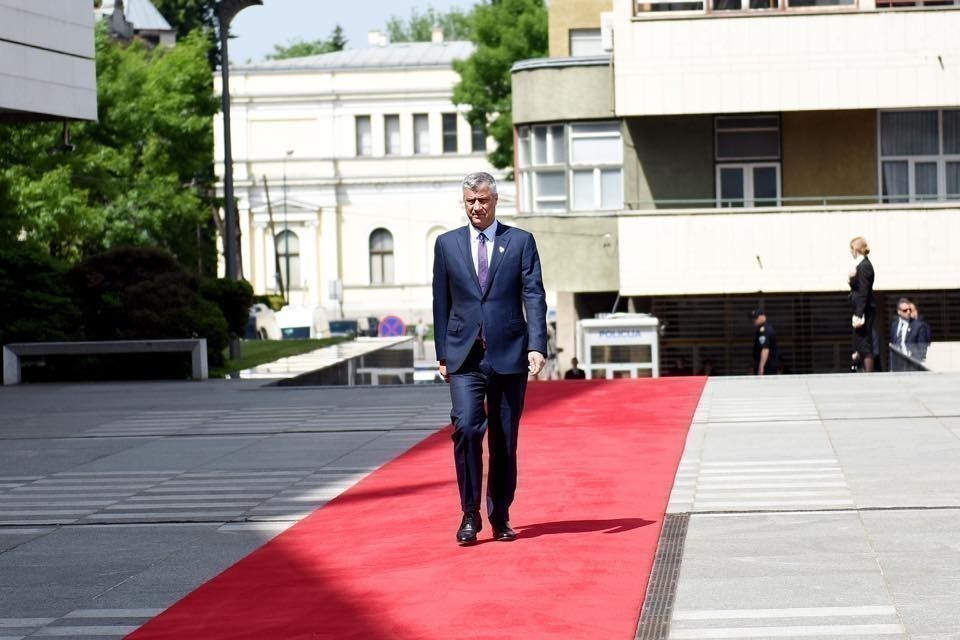
Prishtina, August 24th – President of the Republic of Kosovo, Hashim Thaçi, travelled today to Austria where he will be attending the European Forum, held in Alpbach, Austria.
President Thaçi visits the Islamic Community of Kosovo, congratulates the believers on Eid al Adha
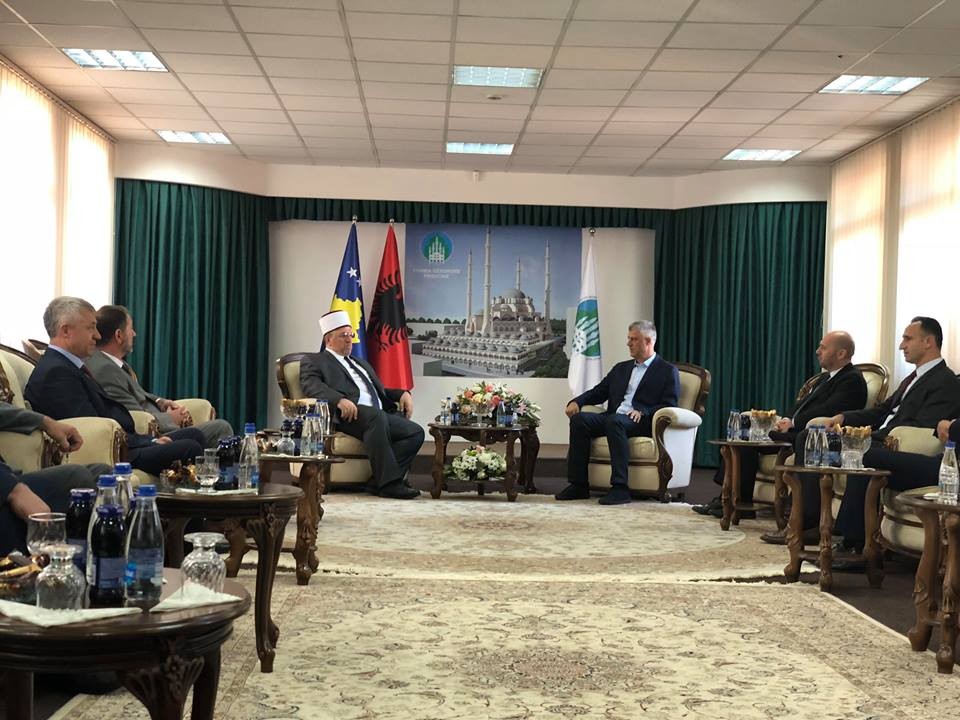
Prishtina, August 21st, 2018 – President of the Republic of Kosovo, Hashim Thaçi, on the occasion of the Eid al Adha, visitied the Islamic Community of Kosova, where he was received by the Mufti Naim Tërnava.
President Thaçi appointed the new judges of the Constitutional Court
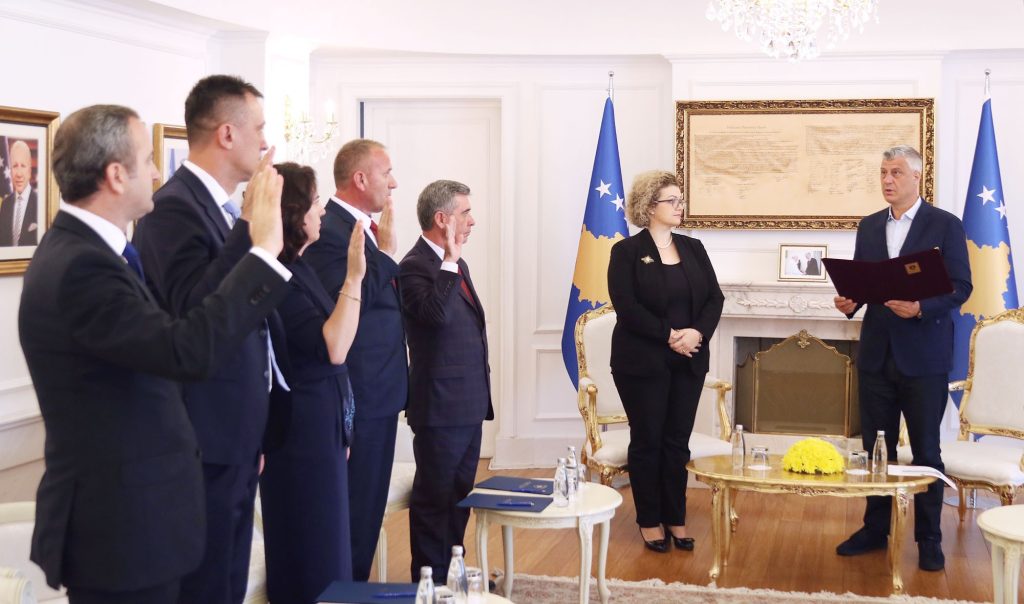
Prishtina, August 9th 2018 – President of the Republic of Kosovo, Hashim Thaçi, based on Article 84 (4, 19), of the Constitution of the Republic of Kosovo, Article 6 of the Law Nr. 03/L- 094 on the President of the Republic of Kosovo (OG Nr. 47, January 25th 2009), Article 7 of the Law Nr. 03/L-121 on the Constitutional Court of Kosovo of the Republic of Kosovo (OG Nr 46, January 15th 2009), in conformity with the proposal of the Parliament of the Republic of Kosovo ( decision of the Parliament of the republic of Kosovo Nr. 06-V-134, dated May 18th 2018 and decision of the Parliament of the Republic of Kosovo, Nr. 06-V-174, dated July 6th 2018) has appointed judges of the Constitutional Court of the Republic of Kosovo.
Statement of the President of the Republic of Kosovo, Hashim Thaçi
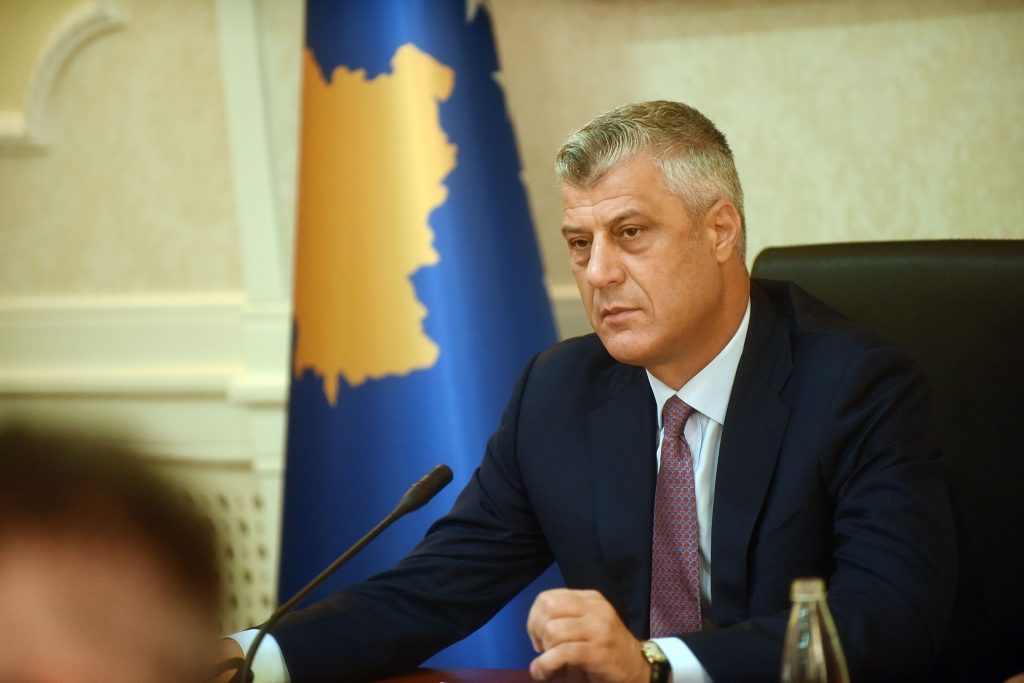
The Republic of Kosovo is committed to the achievement of a legally binding, historical agreement, within the last phase of the dialogue on the normalization of relations between Kosovo and Serbia.
President Thaçi's address at the media conference

Respectable media, Honourable citizens of the Republic of Kosovo; Please allow me to thank you for your presence today here at this conference. As I have made it clear before, the sole aim of this joint communication is the increase of transparency and sending of the right messages to our citizens in relation to issues and important developments in our country, especially the public and institutional debate on the dialogue process between the states of Kosovo and Serbia. Allow me to point out that despite misinterpretations, intentional or non-intentional, rational or irrational statements, possible or impossible scenarios, I see value in the public and institutional debate on the most important process for Kosovo, the dialogue process on normalization, reconciliation and mutual recognition between the states of Kosovo and Serbia. I say so, because only through an open debate, through careful analysis of all possible options, going one step further, and by taking the courage to openly discuss subjects of options which until today were considered as “taboo”, we together, may be able to find a solution to this process, which must be in full compliance with our state interest. Allow me to point out that Kosovo has its own state institutions, which must fulfil their constitutional and legal obligations, including the proper proceedings of the dialogue process. Parliament of the Republic of Kosovo, is the main supervisory institution which will have its final say on the ratification or non-ratification of an eventual agreement, which may result at the end of this process. I have said it few time snow, that the dialogue process with Serbia and the opportunities of achieving of a final agreement for normalisation, mutual recognition, reconciliation, are very slim. But, we all have to do our best, to use each opportunity, even the smallest one, in this limited space, to maybe at the end, achieve a historic, definitive agreement in a peaceful manner, through dialogue. I want to emphasize that dialogue has only one crucial aim: achievement of an inter-state agreement on normalisation, mutual recognition and reconciliation, in a peaceful manner. For this reason, all the actors involved in this process and this public debate, I want to invite them to emphasize the fact that agreement can only be reached via dialogue. Agreement may only be achieved through mutual understanding and in peaceful manner, and under no circumstances under threat of war. Honourable media representatives; Honourable citizens of the Republic of Kosovo; Parliament of Kosovo concluded this spring session with a long debate on dialogue. Unfortunately, all those speeches. Some rational, some fiery and more often than not out of context, did not bring out anything concrete. At the end, the debate ended without a platform, resolution or even a verbal agreement on the proceedings of this process. Differences between the parliamentary political parties in relation to this process and the inability to build a wide consensus, are regrettable. Nevertheless, I still hope in the wisdom and the courage of the leaders of political parties to join together on our common aim, because we do not have time to waste. Those who believe that Kosovo needs not rush and must not take this process so seriously, who think that time is in our favour, are completely wrong, and do not have the faintest idea on the dynamic developments on the international arena. Some still waste their energy in discussing whether the final stage of the dialogue on normalisation of relations must take place now or not. And strangely enough, they purposefully forget the fact that the dialogue on the final agreement has commenced two months ago and so far two important meetings of this final stage have taken place. The forthcoming meeting will be held in September, and the dynamism of other meetings will rise. Kosovo must continue to remain involved in this dialogue process in a responsible and constructive manner. If any of the two sides, Kosovo or Serbia, for whatever reason, refuses the dialogue or pretends to withdraw unilaterally for this process, will be facing serious consequences on its Euro-Atlantic integration process. This fact is sufficient to abnegate the mistaken theories that Kosovo could hinder Serbia, or is able to prevent Serbia’s EU membership, if it leaves the dialogue process. In such an immature act, EU as a mediator and leader of this process, but also the USA and other international partners, will identify Kosovo as an unfit and culpable for escaping from the process and for the failure to achieve a final agreement on inter-state normalisation between Kosovo and Serbia. As a consequence, we all know, that EU would not hesitate at all to, due to lack of Kosovo’s readiness to dialogue an agreement, to enable Serbia’s move ahead towards EU agreement. And Kosovo would risk to loose EU support and the support of our other international partners, and to remain isolated and hopeless in realisation of our aspirations for EU. NATO and UN memberships. So, it must be clear to everyone, that only through constructive and participatory approach, may Kosovo gain the international and EU support. During the last three decades, all those who have refused or boycotted the dialogue have come up looser. Kosovo was involved, has participated in the dialogue and has won. The immature statements that Kosovo has potential to prevent Serbia from becoming an EU member are very naïve. Unfortunately, certain individuals, political leaders, have quite often proved that they poses sufficient negative potential to hinder and isolate Kosovo on its Euro-Atlantic processes but not some other state. In any case, the Parliament of Kosovo remains the sole state institution of representation of the interest of the citizens of the country, which will ratify or not the final agreement between Kosovo and Serbia. The question that pop-ups quite often is: are the political parties represented at the parliament fulfilling their duty towards the interest of the citizens? The adequate answer will be given by the citizens themselves, but I think that the time has come to empower
President Thaçi's address at the media conference
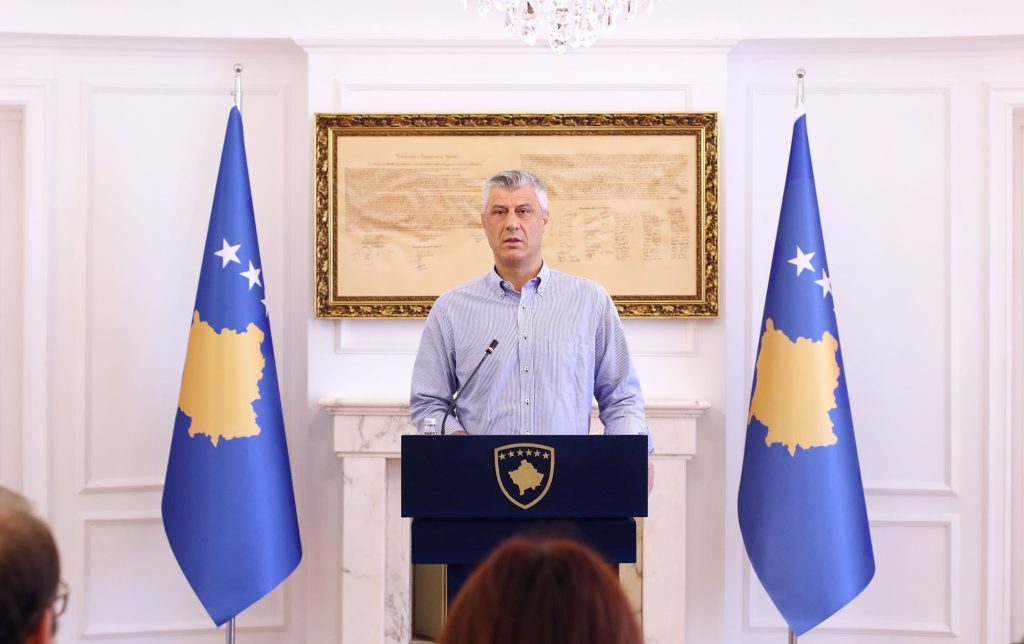
Respectable media, Honourable citizens of the Republic of Kosovo; Please allow me to thank you for your presence today here at this conference. As I have made it clear before, the sole aim of this joint communication is the increase of transparency and sending of the right messages to our citizens in relation to issues and important developments in our country, especially the public and institutional debate on the dialogue process between the states of Kosovo and Serbia. Allow me to point out that despite misinterpretations, intentional or non-intentional, rational or irrational statements, possible or impossible scenarios, I see value in the public and institutional debate on the most important process for Kosovo, the dialogue process on normalization, reconciliation and mutual recognition between the states of Kosovo and Serbia. I say so, because only through an open debate, through careful analysis of all possible options, going one step further, and by taking the courage to openly discuss subjects of options which until today were considered as “taboo”, we together, may be able to find a solution to this process, which must be in full compliance with our state interest. Allow me to point out that Kosovo has its own state institutions, which must fulfil their constitutional and legal obligations, including the proper proceedings of the dialogue process. Parliament of the Republic of Kosovo, is the main supervisory institution which will have its final say on the ratification or non-ratification of an eventual agreement, which may result at the end of this process. I have said it few time snow, that the dialogue process with Serbia and the opportunities of achieving of a final agreement for normalisation, mutual recognition, reconciliation, are very slim. But, we all have to do our best, to use each opportunity, even the smallest one, in this limited space, to maybe at the end, achieve a historic, definitive agreement in a peaceful manner, through dialogue. I want to emphasize that dialogue has only one crucial aim: achievement of an inter-state agreement on normalisation, mutual recognition and reconciliation, in a peaceful manner. For this reason, all the actors involved in this process and this public debate, I want to invite them to emphasize the fact that agreement can only be reached via dialogue. Agreement may only be achieved through mutual understanding and in peaceful manner, and under no circumstances under threat of war. Honourable media representatives; Honourable citizens of the Republic of Kosovo; Parliament of Kosovo concluded this spring session with a long debate on dialogue. Unfortunately, all those speeches. Some rational, some fiery and more often than not out of context, did not bring out anything concrete. At the end, the debate ended without a platform, resolution or even a verbal agreement on the proceedings of this process. Differences between the parliamentary political parties in relation to this process and the inability to build a wide consensus, are regrettable. Nevertheless, I still hope in the wisdom and the courage of the leaders of political parties to join together on our common aim, because we do not have time to waste. Those who believe that Kosovo needs not rush and must not take this process so seriously, who think that time is in our favour, are completely wrong, and do not have the faintest idea on the dynamic developments on the international arena. Some still waste their energy in discussing whether the final stage of the dialogue on normalisation of relations must take place now or not. And strangely enough, they purposefully forget the fact that the dialogue on the final agreement has commenced two months ago and so far two important meetings of this final stage have taken place. The forthcoming meeting will be held in September, and the dynamism of other meetings will rise. Kosovo must continue to remain involved in this dialogue process in a responsible and constructive manner. If any of the two sides, Kosovo or Serbia, for whatever reason, refuses the dialogue or pretends to withdraw unilaterally for this process, will be facing serious consequences on its Euro-Atlantic integration process. This fact is sufficient to abnegate the mistaken theories that Kosovo could hinder Serbia, or is able to prevent Serbia’s EU membership, if it leaves the dialogue process. In such an immature act, EU as a mediator and leader of this process, but also the USA and other international partners, will identify Kosovo as an unfit and culpable for escaping from the process and for the failure to achieve a final agreement on inter-state normalisation between Kosovo and Serbia. As a consequence, we all know, that EU would not hesitate at all to, due to lack of Kosovo’s readiness to dialogue an agreement, to enable Serbia’s move ahead towards EU agreement. And Kosovo would risk to loose EU support and the support of our other international partners, and to remain isolated and hopeless in realisation of our aspirations for EU. NATO and UN memberships. So, it must be clear to everyone, that only through constructive and participatory approach, may Kosovo gain the international and EU support. During the last three decades, all those who have refused or boycotted the dialogue have come up looser. Kosovo was involved, has participated in the dialogue and has won. The immature statements that Kosovo has potential to prevent Serbia from becoming an EU member are very naïve. Unfortunately, certain individuals, political leaders, have quite often proved that they poses sufficient negative potential to hinder and isolate Kosovo on its Euro-Atlantic processes but not some other state. In any case, the Parliament of Kosovo remains the sole state institution of representation of the interest of the citizens of the country, which will ratify or not the final agreement between Kosovo and Serbia. The question that pop-ups quite often is: are the political parties represented at the parliament fulfilling their duty towards the interest of the citizens? The adequate answer will be given by the citizens themselves, but I think that the time has come to empower
President Thaçi visited the Chamber of Commerce: visa liberalisation will help integration in international markets
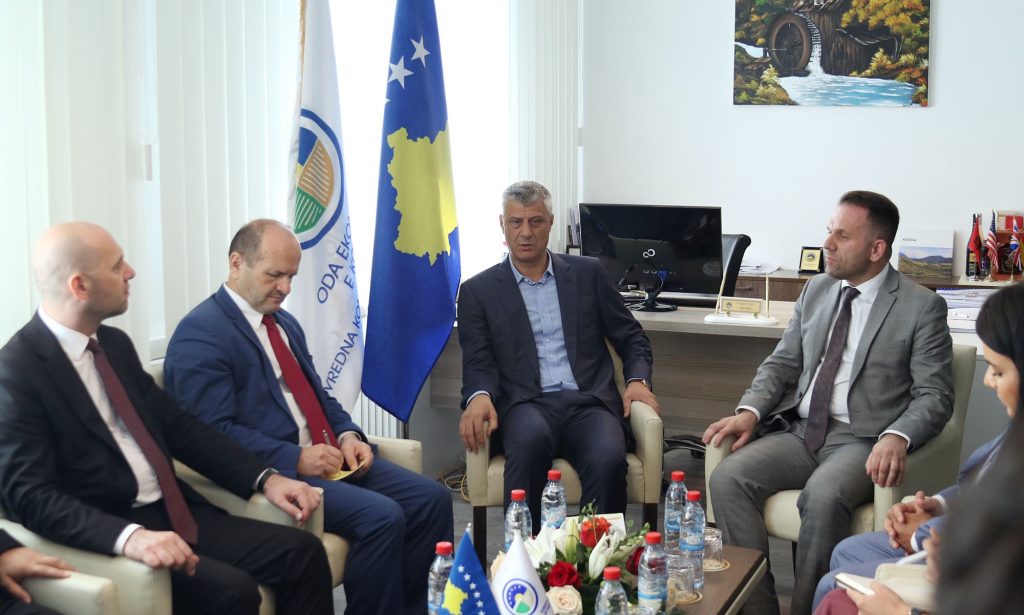
Prishtina, August 2nd 2018 – President of the Republic of Kosovo, Hashim Thaci, visited today the Kosovo Chamber of Commerce. Head of State spoke with the new KCC Chairman, Berat Rukiqi, and with a group of local businessmen, whom he referred to as the men of work and success, who have opened many new work places and who are increasing social wellbeing of our citizens.